
Introduction
When it comes to HVAC system design, temperature control often takes center stage. However, another equally critical factor governs comfort, efficiency, and air quality: psychrometrics. This science deals with the thermodynamic properties of air and water vapor mixtures. Understanding psychrometrics allows engineers to design systems that precisely control humidity, temperature, and airflow—ensuring both performance and comfort.
What Is Psychrometrics?
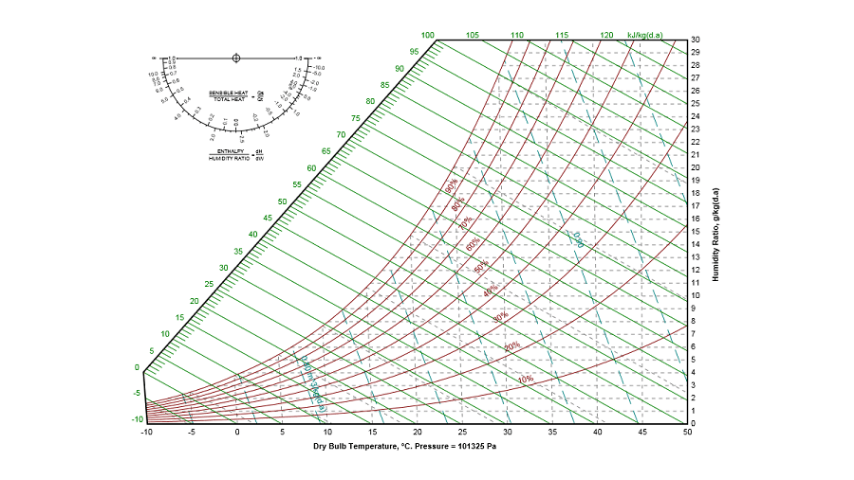
Psychrometrics studies the physical and thermal properties of moist air, including temperature, humidity, enthalpy, dew point, and vapor pressure. These parameters are graphically represented on a psychrometric chart, which engineers use to analyze processes like cooling, heating, humidification, and dehumidification. By interpreting this chart, professionals can determine how air will behave in different scenarios and design equipment accordingly.
Importance in HVAC Applications
Every HVAC process—whether cooling a data center, conditioning hospital air, or dehumidifying a warehouse—relies on psychrometrics. For example, a cooling coil does not just reduce air temperature; it also removes latent moisture, shifting the air’s condition on the psychrometric chart. Ignoring these interactions can result in uncomfortable indoor environments, wasted energy, or even equipment failure.
Energy Efficiency and Control
Precise psychrometric analysis enables energy-efficient designs. By optimizing airflows and moisture removal, HVAC systems can reduce the energy required for dehumidification or reheating. For instance, using energy recovery systems that leverage enthalpy wheels or heat pipes is only effective when psychrometric properties are properly understood and applied.
Specialized Environments
In industries such as pharmaceuticals, aerospace, and food processing, psychrometric control is essential. Even slight deviations in relative humidity can damage sensitive products or create unsafe conditions. Similarly, swimming pool facilities rely on psychrometric principles to prevent excessive evaporation and maintain comfort for occupants.
Conclusion
Psychrometrics may seem highly technical, but it forms the backbone of modern HVAC design. By mastering the relationship between air, moisture, and energy, engineers can create systems that are not only efficient but also tailored to the unique demands of each environment.